
Medical billing A/R follow-up is the work that starts after a claim leaves your office. Someone has to check whether the payer received the claim, whether the payer paid it correctly, and what to do next if it did not.
When nobody owns that work, claims quietly age. A small balance at 30 days can become a hard-to-collect balance at 120 days. By then, a filing or appeal deadline may be close, or it may have passed.
This guide shows how to run medical billing A/R follow-up step by step, which deadlines to watch, and how to decide whether to keep the work in-house.
Show Image
Key Takeaways
- Medical billing A/R follow-up means working unpaid claims by age, dollar value, and cause.
- A healthy overall days-in-A/R number can hide older balances. Track A/R over 90 and 120 days separately.
- Give every unpaid account a named owner, a next action, and a follow-up date.
- Medicare generally requires claims within 12 months of the date of service and first-level appeals within 120 days. Commercial deadlines vary by contract.
- Repeating A/R problems usually start upstream, in eligibility, authorization, coding, or credentialing.
What Is Medical Billing A/R Follow-Up?
Accounts receivable (A/R) is the money your practice has earned but not yet collected. Insurance companies owe most of it. Patients owe the rest.
Medical billing A/R follow-up is the routine of working those unpaid balances until the payer pays, you correct the claim, you appeal, or you properly close the account. It includes:
- Checking claim status with the payer
- Resubmitting claims that the payer rejected or never received
- Sending records when a payer asks for them
- Appealing denials and underpayments
- Following up on patient balances
- Recording what happened so the next person does not start over
Follow-up sits between claim submission and denial management. A denial is one reason a claim stays open. Follow-up also covers claims that are silent, pending, or paid incorrectly. For a closer look at denials, read Denial Management Services: 6 Things to Expect.
Why Medical Billing A/R Follow-Up Matters
Old claims do not simply wait. They get harder to collect.
- Deadlines get closer. Payers set filing and appeal windows. If you miss one, the payer can refuse payment.
- Details get lost. Staff change, notes go missing, and payer contacts move on.
- Staff time grows. An account you touch five times costs more than one you work correctly the first time.
- Cash flow suffers. Late payments make it harder to plan payroll, supplies, and hiring.
The American Academy of Family Physicians (AAFP) warns that a good overall days-in-A/R number can hide a growing pile of older receivables. It also gives a useful example: if your practice averages about 50 days but one payer averages 75, review that payer on its own. Averages hide payer-specific problems.
Know Your Numbers Before You Start
You cannot manage what you do not measure. Start with three numbers.
1. Days in A/R. Divide total A/R by your average daily charges. AAFP says to keep this number below 50 days at a minimum, with 30 to 40 days preferable. Subtract credits first, or the result will look better than it is.
2. Percentage of A/R over 90 and 120 days. Group your balances into age buckets: 0–30, 31–60, 61–90, 91–120, and over 120 days. Older guidance based on MGMA data suggests better-performing practices keep no more than about 10% of A/R over 120 days. Treat that as a reference point, not a rule, because specialty and payer mix change the target.
3. Net collection rate. This compares what you collected with what your contracts entitle you to collect. AAFP names 95% as the minimum adjusted collection rate to aim for.
Use the same calculation every month so the trend means something. For standard definitions, see the HFMA MAP Keys. For a full monthly dashboard, read our guide to revenue cycle KPIs. To see how denials feed into aging, read our claim denial rate guide.
A Weekly Medical Billing A/R Follow-Up Routine in 6 Steps
You do not need a complicated system. You need a routine that runs every week.
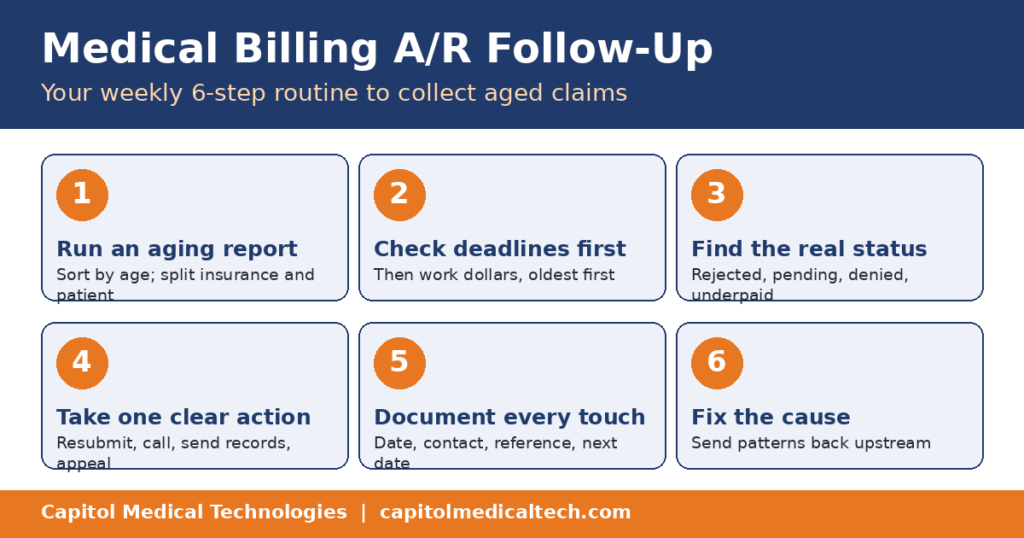
- Run an aging report. Sort balances by age and split insurance from patient balances, because they follow different workflows.
- Check deadlines first, then dollars. A smaller claim close to a filing or appeal deadline can matter more than a larger claim with months left.
- Find the real status. Decide whether the payer rejected the claim, never received it, is still processing it, denied it, or paid it incorrectly, or whether you are waiting on a patient or another payer.
- Take one clear action. Correct and resubmit, call the payer, send records, file an appeal, or bill the next responsible party.
- Document every touch. Record the date, the person you spoke with, the reference number, what they said, and the next follow-up date.
- Fix the cause, not only the claim. Track the top reasons by payer and send them back to the front desk, coders, or credentialing team.
That last step saves practices the most money. If the same issue keeps appearing, the fix belongs upstream. Our post on front desk revenue gaps shows how registration errors turn into aged claims weeks later.
Medical Billing A/R Follow-Up Deadlines to Put on Your Calendar
Missed deadlines are the most expensive A/R mistake because you cannot undo them. Keep a payer deadline sheet and review it weekly.
| Deadline | What to know |
|---|---|
| Medicare claim filing | Fee-for-service claims generally need filing within one calendar year of the date of service, with limited exceptions under 42 CFR 424.44. Medicare does not treat claims it rejects as unprocessable as filed, so correct and resubmit them quickly. |
| Medicare first-level appeal | You generally must request a redetermination within 120 days of receiving the remittance advice, and contractors generally decide within 60 days. See the CMS appeals booklet. |
| Commercial payers | Filing, corrected-claim, and appeal windows vary by contract and plan. Check each payer agreement. |
| Patient balances | Follow your written billing policy and your state’s rules on statements and payment plans. |
This is general information, not legal advice. Confirm current rules with your Medicare Administrative Contractor and your payer contracts.
Common Problems in Medical Billing A/R Follow-Up and How to Fix Them
| What you see | Likely cause | What to do |
|---|---|---|
| Claims never reach the payer | Wrong payer or patient data, clearinghouse rejection | Review rejection reports daily and verify coverage before the visit with eligibility and benefits verification |
| Claims sit with no response | Payer is still processing, or asked for records | Check status at a set interval, document it, and escalate when the payer’s stated window passes |
| Repeated authorization denials | Missing or expired authorization | Track authorization numbers and dates. See prior authorization services |
| Denials for a provider not covered | Enrollment or credentialing gap | Review credentialing and enrollment status and read how to credential a new provider |
| Underpayments | Contract rates not loaded or not checked | Compare each payment with the fee schedule. AAFP recommends keeping fee schedules on hand to avoid inappropriate write-offs |
| Patient balances keep aging | No estimate or clear statement at the visit | Collect at check-in when possible. Read what to check before every visit |
Behavioral health practices often face extra payer rules, authorization limits, and telehealth billing issues. Our behavioral health claim denial appeal guide and telehealth billing checks cover those cases in detail.
Should You Handle Medical Billing A/R Follow-Up In-House?
In-house follow-up works well when one person has protected time, someone reviews aging reports weekly, and older accounts are not growing.
It may be time to get help when:
- A/R over 90 days keeps rising
- Follow-up gets pushed aside by front desk and patient work
- Staff turnover leaves accounts without an owner (see the real cost of front desk turnover)
- Your practice is growing faster than your billing capacity (see medical billing for small practices)
To compare options, start with our in-house vs. outsourced billing cost breakdown and our medical billing services checklist. For a broader overview, read Outsourcing Medical Billing Services: A Practice Guide.
You do not have to hand over everything. Many practices outsource only a defined work queue, such as A/R follow-up or insurance verification.
If you outsource, sign a business associate agreement first. HHS explains that the HIPAA Rules generally require contracts between covered entities and their business associates. Also agree on who works which queue, how often you will get reports, and how the team will escalate problems.
How CMT Supports Medical Billing A/R Follow-Up
Capitol Medical Technologies (CMT) helps independent practices with medical billing and revenue cycle management, including payment posting, insurance follow-up, denial management, appeals support, and reporting. We work inside your approved systems, use Business Associate Agreements where applicable, and charge no setup fees and require no long-term contracts. Read more on our HIPAA and security page and about page.
Here is one example. A multi-specialty group came to us with more than $180,000 in A/R over 120 days, a 17% denial rate, and limited visibility after working with several billing vendors. Over six months, we audited the aged receivables, prioritized recoverable claims, launched structured appeals, and tightened charge-capture and coding handoffs. A/R over 120 days fell by 78%, and A/R days dropped from 71 to 29. See the full client outcomes on our homepage. These results come from an anonymized engagement and do not guarantee future performance.
We also support specialty practice RCM and behavioral health billing.
Frequently Asked Questions
What is medical billing A/R follow-up?
It is the process of tracking and working unpaid claims and patient balances until the payer pays, you correct the claim, you appeal, or you close the account. It includes payer status checks, resubmissions, appeals, and documentation.
How often should you work aged A/R?
Most practices review an aging report at least weekly. Rejections and accounts near a deadline need attention sooner.
What is a good days in A/R number?
AAFP recommends staying below 50 days at a minimum, with 30 to 40 days preferable. Benchmarks vary by specialty and payer mix, so compare your own trend over time.
When should you escalate an unpaid claim?
Escalate when the payer’s stated processing window has passed, when the payer requested records and you have not answered, or when a filing or appeal deadline gets close. Check each payer contract for its timelines.
Can you outsource only medical billing A/R follow-up?
Yes. CMT can support a full revenue cycle or a defined work queue such as A/R follow-up, denials, eligibility, or authorizations.
Does CMT guarantee collections?
No. Payer rules, contracts, coverage, documentation, and coding all affect reimbursement. We provide disciplined follow-up and clear reporting, and we do not promise outcomes we cannot control.
The Bottom Line
Practices rarely lose money on A/R in one big moment. They lose it slowly, one unworked account at a time.
Start small this week. Run an aging report, pick the 10 accounts with the nearest deadlines or highest balances, and give each one an owner and a next action. Then review the pattern behind them.
Want help with medical billing A/R follow-up? Request a free revenue review with CMT.
Call: 571-410-3703 Email: info@capitolmedicaltech.com
Sources and Further Reading
- AAFP: Managing practice finances
- HFMA MAP Keys
- 42 CFR 424.44: Time limits for filing claims
- First Coast Medicare: timely filing guidance
- CMS: Medicare Part B appeals process (MLN booklet)
- CMS: First level of appeal, redetermination by a Medicare contractor
- HHS: Sample business associate agreement provisions
- American College of Allergy, Asthma & Immunology: How healthy is your practice?