Medical documentation is an essential part of patient care, but it can also consume valuable physician time.
According to the American Medical Association (AMA), a time-and-motion study found that physicians spent nearly two additional hours on electronic health records (EHRs) and desk work for every hour of direct patient care during the clinic day.
This administrative burden can leave physicians completing clinical notes long after appointments end.
For independent medical practices, the challenge is finding a better way to manage documentation without sacrificing accuracy, patient safety, or clinical oversight.
What does a medical scribe do, and how can this role help your practice?
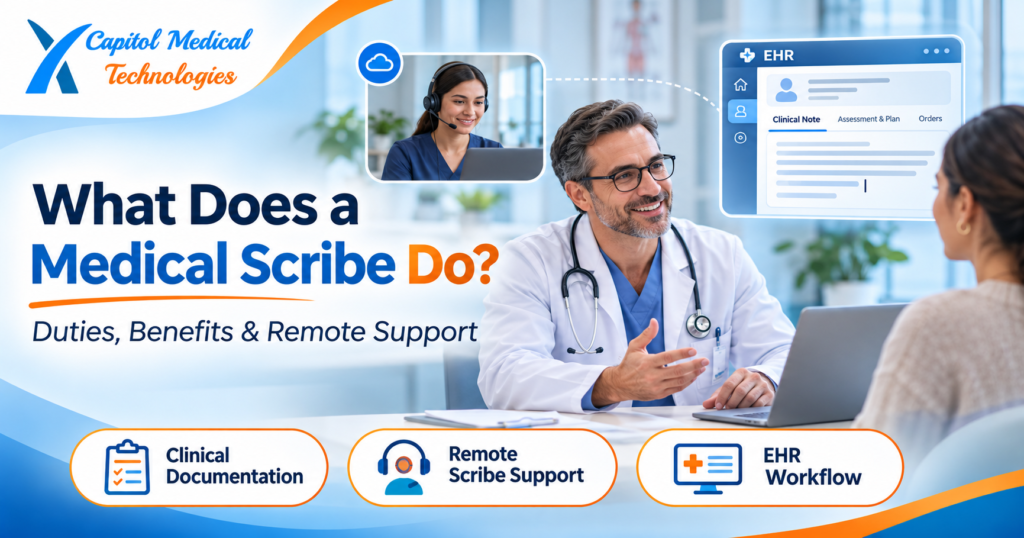
A medical scribe assists healthcare providers with clinical documentation, patient chart preparation, and EHR-related tasks. Scribes can work in person or remotely, depending on the practice’s needs.
This guide covers medical scribe responsibilities, the difference between a medical scribe and a medical assistant, virtual scribe workflows, and the potential benefits for independent practices.
What Does a Medical Scribe Do?
A medical scribe is a trained documentation specialist who helps healthcare providers record and organize information from patient encounters.
The medical scribe typically works within the practice’s existing EHR system to prepare clinical notes and assist with documentation-related tasks.
Common medical scribe duties include:
- Preparing patient charts before appointments.
- Documenting the history of present illness (HPI).
- Recording review of systems (ROS) information.
- Entering physician-dictated examination findings.
- Drafting assessment and treatment plans.
- Organizing relevant medical history and diagnostic results.
- Preparing documentation for clinician review and signature.
Medical scribes support documentation but do not independently diagnose patients, prescribe medications, or make treatment decisions.
The treating clinician remains responsible for reviewing, correcting, and authenticating the final medical record.
Practices looking for dedicated documentation assistance can explore medical scribe services and transcription support from Capitol Medical Technologies.
What Are the Daily Responsibilities of a Medical Scribe?
A medical scribe’s daily responsibilities generally follow the clinical encounter from preparation to documentation completion.
1. Preparing Patient Charts Before Appointments
Before a patient arrives, a medical scribe may organize information already available in the EHR.
Typical tasks include:
- Reviewing previous progress notes.
- Identifying relevant medical history.
- Organizing laboratory and imaging results.
- Reviewing documented medications and allergies.
- Preparing the appropriate encounter template.
- Flagging missing information for clinician review.
This process is often called pre-visit chart preparation or chart scrubbing.
For example, a physician seeing a patient with diabetes may need recent laboratory results, medication history, and previous treatment plans.
Organizing that information before the appointment can help reduce interruptions during the visit.
Practices managing significant administrative workloads may also benefit from medical virtual assistant services for patient intake, scheduling, record requests, and other approved support tasks.
2. Documenting Patient Encounters Using SOAP Notes
One of the primary medical scribe duties is preparing encounter documentation.
Many healthcare providers use the SOAP format.
Subjective
The scribe documents information communicated during the encounter, including:
- Chief complaint.
- History of present illness.
- Relevant symptoms.
- Review of systems.
- Patient-reported concerns.
Objective
The scribe records objective information supplied or confirmed by the clinician, including vital signs, examination findings, and relevant diagnostic results.
Assessment
The scribe documents the clinician’s diagnoses and clinical assessment without independently making those determinations.
Plan
The scribe records the provider’s treatment plan, including medications, tests, referrals, and follow-up instructions.
The clinician reviews the resulting documentation before signing it.
The Centers for Medicare & Medicaid Services (CMS) guidance on medical record documentation explains the importance of complete, legible records that support the services provided.
3. Supporting Electronic Health Record Workflows
Medical scribes may also assist with EHR clinical documentation support.
Depending on the practice’s policies, system permissions, and applicable requirements, responsibilities may include:
- Preparing draft encounter notes.
- Organizing documentation fields.
- Identifying incomplete clinical narratives.
- Tracking outstanding provider clarifications.
- Preparing provider-directed order requests for authorized review.
- Maintaining documentation work queues.
Medical scribes should not independently authorize orders or use another clinician’s login credentials.
A well-defined workflow helps ensure that scribes, medical assistants, physicians, and billing staff understand their individual responsibilities.
For practices managing multiple administrative processes, Capitol Medical Technologies’ virtual medical assistants can provide additional support for approved nonclinical tasks.
4. Preparing Notes for Physician Review
After the visit, a medical scribe helps prepare the documentation for final review.
This may include:
- Checking whether required note sections are complete.
- Identifying inconsistent or unclear information.
- Flagging missing details for clarification.
- Organizing relevant supporting information.
- Preparing the encounter for clinician authentication.
The scribe must not add unsupported findings, diagnoses, or treatment details.
Accurate clinical documentation matters not only for patient care but also for appropriate medical billing and revenue cycle management.
Medical Scribe vs. Medical Assistant: What Is the Difference?
Medical scribes and medical assistants both support healthcare providers, but their primary responsibilities differ.
A medical scribe focuses on documentation.
A medical assistant generally supports clinical intake, office workflows, and permitted patient care activities within applicable law and practice policies.
| Responsibility | Medical Scribe | Medical Assistant |
|---|---|---|
| Main focus | Clinical documentation | Patient intake and clinical support |
| EHR documentation | Detailed encounter notes | Intake and assigned documentation |
| Vital signs | Records supplied information | May measure and record |
| Clinical procedures | Does not perform procedures | May perform permitted procedures |
| Patient rooming | Not a core duty | Common responsibility |
| Remote work | Often possible | Some administrative duties can be remote |
| Treatment decisions | Not permitted | Not independently permitted |
Which Role Does Your Practice Need?
A medical scribe may be appropriate when physicians spend excessive time documenting encounters.
A medical assistant may be more appropriate when patient intake, rooming, and clinical preparation are the main challenges.
Some practices benefit from using both.
For example, a medical assistant may prepare the patient for the appointment while a medical scribe handles the physician’s documentation.
If your practice needs help with scheduling, referrals, insurance information, or patient communication, explore our medical virtual assistant services.
What Is a Remote Medical Scribe?
A remote medical scribe provides documentation support from outside the physical practice.
Instead of sitting in the examination room, the scribe works through authorized remote systems and practice-approved procedures.
Remote medical scribes generally operate through two models.
Real-Time Virtual Medical Scribes
A real-time virtual scribe assists while the patient encounter is taking place.
The typical process includes:
- The clinician begins the patient encounter.
- The scribe follows the visit through an approved, secure connection.
- The scribe prepares the draft note.
- The clinician reviews and corrects the documentation.
- The clinician authenticates the completed record.
This model may help physicians reduce the amount of documentation they perform during and after appointments.
Asynchronous Remote Medical Scribes
An asynchronous medical scribe prepares documentation after the encounter.
The practice supplies authorized source materials, such as recorded dictation or approved encounter information.
The scribe prepares the clinical note for physician review.
This option may suit practices that prefer documentation support outside live clinic hours.
A study published in JAMA Network Open, Virtual Scribes and Physician Time Spent on Electronic Health Records, found that virtual scribe use was associated with reduced EHR time, note time, and after-hours documentation time.
Results vary by specialty and implementation.
CMT offers options for live medical scribing, asynchronous documentation, and medical transcription based on an agreed practice workflow.
Benefits of Remote Medical Scribes for Independent Practices
Remote medical scribe services may help medical practices manage documentation workloads while maintaining established clinical processes.
1. Reduce After-Hours Documentation
Physicians often complete unfinished notes after the clinic closes.
Remote medical scribes can prepare draft notes so clinicians have less documentation to complete independently.
An AMA review of virtual scribe research discusses reductions in EHR time associated with virtual scribe use.
Actual results depend on visit complexity, EHR integration, staffing, and physician review requirements.
2. Support More Focused Patient Visits
A medical scribe can reduce the need for physicians to type continuously during patient conversations.
This may support better eye contact, communication, and attention during appointments.
For independent clinics seeking more efficient workflows, our guide to medical billing for small practices also explains why administrative workload and clearly assigned responsibilities matter.
3. Improve Documentation Consistency
A trained scribe can follow established templates and documentation standards.
This may help reduce incomplete notes and make documentation easier for clinicians to review.
Consistent records are especially important when practices need supporting documentation for insurance claims or other administrative processes.
4. Provide Flexible Staffing Support
Remote scribes may reduce the need for additional physical workspace.
Practices can also discuss documentation support appropriate to their specialty and appointment schedule.
However, successful implementation still requires secure systems, training, quality monitoring, and clear clinician oversight.
5. Help Manage Documentation Backlogs
Unfinished charts can affect several parts of a practice.
For example, completed visits may remain unavailable for billing review until required documentation is finalized.
Organized scribe support may help reduce this backlog.
Practices can combine documentation support with medical billing services to improve visibility into where encounters are waiting for review or claim preparation.
How Medical Scribes Support the Revenue Cycle
Medical scribes are not billing specialists, but their work can support the documentation processes that medical billing depends on.
Timely Documentation and Claim Preparation
Medical claims often require completed encounter documentation.
When clinical notes remain unfinished, charge review and claim preparation may be delayed.
A scribe may help prepare documentation promptly so clinicians can finalize their records sooner.
For a broader view of billing responsibilities, read our medical billing services checklist for practice owners.
Accurate Clinical Documentation for Coding
Clinical documentation should accurately reflect the services performed.
Medical scribes help record the clinician’s assessment and plan, but they must not invent information or independently determine billing codes.
The CMS Evaluation and Management Visits guidance provides resources on E/M documentation and payment requirements.
Accurate documentation is one component of a reliable revenue cycle management workflow.
Documentation for Prior Authorization
Some diagnostic tests, procedures, and treatments require prior authorization.
Clear documentation may help authorized staff gather the clinical information necessary for a payer submission.
For example, a prior authorization request may require the provider’s diagnosis, treatment history, examination findings, or documented rationale.
Medical scribes can support the underlying record keeping, while authorized personnel manage the submission and provider attestations.
Learn more about CMT’s prior authorization services and our guide explaining what a prior authorization specialist does.
Supporting Denial Prevention Workflows
Incomplete or inconsistent documentation can contribute to claim questions and payment delays.
Medical scribes may help practices identify missing information before it creates additional administrative work.
However, not every denial is documentation-related.
Other common issues include coverage problems, missing authorizations, coding discrepancies, and payer processing requirements.
For additional information, explore our denial management services and behavioral health claim denials appeal guide.
Medical Scribes vs. AI Medical Scribes
Artificial intelligence is changing the way healthcare organizations approach clinical documentation.
An AI medical scribe generally uses speech recognition and language-processing technology to create draft notes from patient encounters.
A human medical scribe prepares documentation using approved clinical source information and established workflows.
Both approaches have strengths and limitations.
| Feature | Human Medical Scribe | AI Medical Scribe |
|---|---|---|
| Documentation | Human-assisted | Automated draft generation |
| Medical terminology | Depends on training | Depends on system performance |
| Workflow adaptation | Can follow approved custom procedures | Depends on software capabilities |
| Common risks | Human omissions or entry errors | Inaccurate or incomplete generated notes |
| Provider review | Required | Required |
| Privacy safeguards | Required | Required |
Are AI Medical Scribes Accurate?
AI scribes can reduce manual documentation tasks, but generated notes still require careful clinician review.
A 2025 study published in JAMA Network Open examined the association between ambient AI scribe use and clinician administrative burden and burnout.
Its findings suggest potential benefits, but results from one implementation should not be treated as guaranteed outcomes for every practice.
Likewise, human medical scribes require appropriate training, quality review, and supervision.
For most practices, the decision should be based on documentation accuracy, privacy, total workflow burden, cost, and clinician experience.
Are Remote Medical Scribes HIPAA-Compliant?
Remote medical scribe services may involve access to protected health information (PHI).
Healthcare organizations must ensure that their documentation processes comply with applicable privacy and security requirements.
Important safeguards may include:
- Appropriate Business Associate Agreements (BAAs).
- Role-based EHR permissions.
- Unique user credentials.
- Secure remote connections.
- Workforce privacy and security training.
- Access monitoring.
- Procedures for reporting security incidents.
- Appropriate handling of recorded encounters.
The U.S. Department of Health and Human Services (HHS) guidance on business associates explains the responsibilities of organizations that handle PHI on behalf of covered entities.
Practices can also review CMT’s HIPAA and data security information when evaluating documentation outsourcing.
A service should not be considered compliant merely because it uses encrypted communication. The complete workflow and organizational safeguards matter.
How to Choose the Right Remote Medical Scribe Service
Before outsourcing documentation, independent practices should evaluate the provider’s operational capabilities.
1. Specialty Experience
Ask whether the service can support your specialty’s terminology, clinical note formats, and documentation workflows.
Requirements may differ across primary care, cardiology, behavioral health, pain management, and surgical specialties.
2. EHR Compatibility
Confirm whether the scribe can work within your existing EHR through authorized access.
Avoid unnecessary duplicate systems and manual data transfer whenever practical.
3. Security and Privacy
Review how the service protects patient information.
Confirm BAA requirements, access controls, training, and incident response procedures.
4. Documentation Quality
Ask how the provider handles incomplete information, transcription discrepancies, and note corrections.
5. Physician Oversight
Ensure the clinician retains responsibility for reviewing and authenticating documentation.
6. Coverage and Availability
Discuss schedules, backup staffing, turnaround times, and escalation procedures.
7. Performance Measurement
Consider tracking:
- Average note completion time.
- Percentage of encounters documented the same day.
- Physician after-hours documentation time.
- Documentation correction rates.
- Unfinished chart backlog.
- Clinician satisfaction.
When evaluating an outsourced service, practices should also review the principles discussed in our medical billing outsourcing checklist.
How Capitol Medical Technologies Can Help
At Capitol Medical Technologies, we help independent healthcare practices manage clinical documentation, administrative workloads, and revenue cycle processes.
Our medical scribe services are designed around practice-defined workflows, specialty terminology, documentation requirements, and clinician review.
Depending on the agreed scope, support options include:
- Live medical scribe assistance.
- Asynchronous clinical documentation support.
- Recorded dictation transcription.
- Template-based clinical note preparation.
- Documentation queue management.
- Coordination of outstanding clinician clarification requests.
We also provide complementary services to support other parts of the practice:
Medical Virtual Assistant Services
Remote administrative support for scheduling, intake, referrals, patient communication, and follow-up.
Medical Billing and Revenue Cycle Management
Support for claims, payment posting, accounts receivable, and billing follow-up.
Eligibility and Benefits Verification
Insurance verification and documentation of relevant coverage information before appointments.
Administrative coordination of payer requirements, supporting documents, submissions, and follow-up.
Claim review, denial analysis, appeals coordination, and recurring issue identification.
Credentialing and Enrollment Services
Provider enrollment, documentation coordination, application tracking, and payer follow-up.
Together, these services can help practices build more organized workflows from patient intake through clinical documentation and reimbursement.
Frequently Asked Questions About Medical Scribes
What does a medical scribe do during a patient visit?
A medical scribe documents information from the patient encounter, including the medical history, examination findings, and provider’s assessment and treatment plan. The clinician reviews and signs the completed note.
Can a medical scribe work remotely?
Yes. A remote medical scribe can support live or asynchronous documentation using authorized systems and approved workflows. Learn more about remote medical scribe support.
What is the difference between a medical scribe and a medical assistant?
A medical scribe primarily handles clinical documentation. A medical assistant supports patient intake, clinic operations, and permitted clinical activities.
Can a medical scribe enter orders?
Depending on applicable rules, practice policies, and system permissions, a scribe may prepare provider-directed orders for review. The scribe cannot independently prescribe treatments or authorize clinical orders.
Do medical scribes help with insurance claims?
Medical scribes do not normally submit claims as a core responsibility. They support documentation that may be needed for accurate billing. Learn more about CMT’s medical billing services.
Can a medical scribe help reduce physician burnout?
Documentation support may reduce administrative workload and after-hours charting for some clinicians. Outcomes depend on the practice’s implementation and documentation requirements.
Are virtual medical scribes secure?
Virtual scribe services can operate within secure, compliant workflows when appropriate safeguards are in place. Practices should evaluate each vendor’s privacy procedures, access controls, and contractual requirements.
How much does a remote medical scribe cost?
Pricing depends on the documentation model, specialty, workload, coverage hours, and level of support. Practices should request a scope-based proposal rather than compare hourly rates alone.
Final Thoughts: What Does a Medical Scribe Do for Your Practice?
A medical scribe helps healthcare providers prepare and organize clinical documentation.
The role may include pre-visit chart preparation, encounter documentation, EHR support, and preparing notes for clinician review.
For independent medical practices, an effective scribe workflow can help reduce administrative friction, improve documentation organization, and support more focused patient care.
Remote medical scribe services offer an additional option for practices that need flexible documentation support without adding an in-person team member.
The best solution is one that fits your specialty, EHR, clinical workflow, and documentation requirements.
Looking for Medical Scribe Support?
Capitol Medical Technologies provides medical scribe, transcription, virtual assistant, and revenue cycle support for independent healthcare practices.
Explore Our Medical Scribe Services
Contact Capitol Medical Technologies to discuss your documentation workflow and support requirements.
Website: https://capitolmedicaltech.com/